
How Toronto Humidity Affects Hardwood Flooring
Toronto homes swing from 60% relative humidity in summer to 15% in winter. Here is what that does to hardwood, and how to install floors that can handle it.
6 min read | Updated 2026-05-24
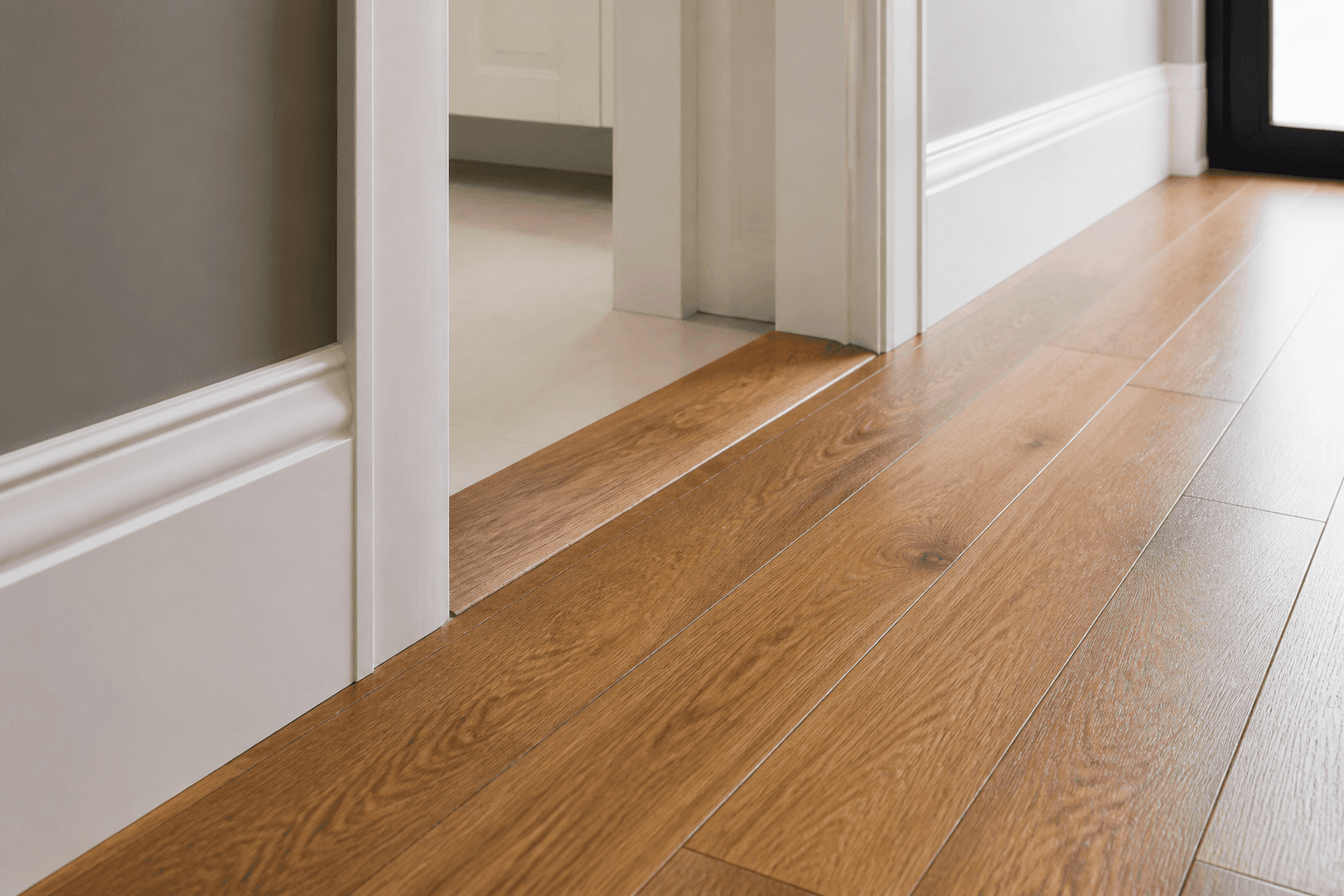
Toronto humidity is harder on hardwood than most homeowners realize
Most flooring problems Toronto homeowners blame on the installer trace back to humidity. Toronto sits in a humid continental climate. Summer relative humidity (RH) regularly reaches 60 to 75 percent indoors. Winter heating drops indoor RH to 15 to 25 percent in homes without humidification. That is a swing of roughly 50 percentage points across one calendar year.
Wood is hygroscopic. It expands when it absorbs moisture from the air and contracts when it releases moisture. A 5 inch wide oak plank can swing in width by 1/16 to 1/8 inch between July and February in an unconditioned Toronto home. Multiply that by 30 boards across a living room and the gaps, squeaks, or cupping become impossible to ignore.
The fix is not to avoid hardwood. It is to install it with the climate in mind.
What humidity does to hardwood: cupping, crowning, and gapping
Three failure modes show up in Toronto homes when humidity is not managed.
• Cupping: the edges of each board rise higher than the centre, creating a shallow trough. This happens when the bottom of the board absorbs more moisture than the top, usually from a damp subfloor, a basement below, or summer humidity entering through a slab. Cupping is the most common Toronto hardwood complaint.
• Crowning: the centre of each board rises higher than the edges. This is less common and usually follows aggressive sanding of a previously cupped floor before the moisture imbalance was corrected. Crowning is hard to reverse.
• Gapping: boards shrink and pull apart at the seams, leaving visible gaps. This appears in winter when furnaces run for weeks at 15 to 20 percent RH. Small seasonal gaps are normal. Gaps wide enough to catch a coin are a sign the install or the climate control needs attention.
All three can be prevented with the right acclimation, expansion gaps, and indoor humidity range during installation.
Acclimation: the step most rushed installs skip
Acclimation is the process of letting hardwood reach moisture equilibrium with the room it will live in before installation. The boards arrive at whatever moisture content the manufacturer shipped them at. The room has its own moisture content. If the boards are installed before they equalize, they will move after installation in ways that the expansion gap cannot accommodate.
For solid hardwood in a Toronto home, acclimation typically takes 5 to 7 days in the room where the floor will be installed, with the boxes opened and the boards spread or stickered to allow airflow. For engineered hardwood, manufacturers vary: some require 48 to 72 hours, others state acclimation is not required for their core construction.
The room should be at the temperature and humidity it will normally be lived in. Acclimating boards in an unheated condo in February and then turning the heat on after install is the most reliable way to cause gaps in March.
Expansion gaps: where the floor needs room to move
Hardwood floors need an expansion gap at every perimeter wall and around every fixed obstacle (columns, kitchen island bases, fireplace hearths, tile thresholds). The standard expansion gap is 3/8 to 1/2 inch for solid hardwood and 1/4 to 3/8 inch for engineered hardwood, but check the specific product instructions because some wider planks specify larger gaps.
The gap is hidden behind baseboard or quarter round. It allows the floor to expand uniformly when summer humidity arrives. A floor installed tight to the wall on a January day will buckle along that wall the following August. The damage often shows as a ridge or a popped board near a sunny window.
For Toronto installations, the expansion gap is not optional. It is the mechanism that makes seasonal humidity swings survivable.
Indoor humidity control: what the manufacturer warranty actually requires
Most hardwood manufacturers specify an indoor RH range of 35 to 55 percent year-round for warranty coverage. In Toronto winters, that range cannot be maintained without active humidification. A typical unhumidified Toronto home in February sits at 15 to 25 percent RH — well below the warranty floor.
For homeowners installing hardwood, this means one of three things:
• A whole-house humidifier attached to the furnace, sized for the home volume and maintained annually.
• Standalone humidifiers in the rooms with hardwood, run during the heating season.
• Acceptance that seasonal gaps will appear and the manufacturer warranty may not cover the resulting movement.
The third option is legitimate if the homeowner understands the trade-off. The seasonal gaps close again when summer humidity returns. The floor is not damaged in any permanent sense. But the warranty position is weaker if a manufacturer-defined defect appears.
Which products handle Toronto humidity best
Some hardwood and engineered hardwood products handle the Toronto humidity swing better than others.
• Engineered hardwood with a multi-ply core: more dimensionally stable than solid hardwood. The cross-laminated core resists the directional movement that causes cupping and gapping.
• Narrower plank widths (3 to 4 inches): move less in absolute terms than wide planks (6 to 9 inches). Wide planks are beautiful but unforgiving in unhumidified Toronto homes.
• Quarter-sawn or rift-sawn solid hardwood: cuts the wood across the grain in a way that reduces seasonal movement compared to flat-sawn lumber. More expensive but more stable.
• Lower-moisture-equivalent species (white oak, hickory): generally more stable than higher-movement species (maple, beech, birch).
For a Toronto homeowner who wants real wood and is not committed to year-round humidification, engineered hardwood with a 3 to 5 inch plank width is usually the most forgiving choice. For a homeowner who wants solid hardwood and is willing to humidify, white oak in a 4 inch plank is a defensible default.
When in doubt, install in spring or fall
Toronto humidity is closest to a yearly average in April through May and September through October. Floors installed in these shoulder seasons start at a moisture content close to the annual mean and have less to adjust to in either direction.
A summer install captures the floor at peak expansion. A winter install captures the floor at peak contraction. Both are workable with proper acclimation and humidity control, but shoulder-season installations have the most forgiving margin for error.
For homeowners planning a hardwood install in Toronto, building in flexibility on the start date — even by a few weeks — can mean the difference between a floor that moves visibly twice a year and one that settles in and stays put.
Frequently Asked Questions
More Flooring Guides
Related Reading
4 min read
Hardwood vs Engineered Hardwood in Toronto Homes
Solid hardwood is not automatically better. The right choice depends on the room, subfloor, humidity, and installation method.
Read guide8 min read
Heated Floors and Flooring Choice in Toronto: What Works Over Radiant
In-floor heat changes which flooring you can install. Some products de-rate above 28°C. Some void warranty over radiant. Here is what actually works.
Read guide7 min read
How Long Does Flooring Installation Take in Toronto? A Realistic Timeline
A 1,000 sq ft condo is not the same as a 1,000 sq ft house. Here is how long flooring installation actually takes in Toronto — from measurement to the last baseboard.
Read guideLocal Flooring Pages